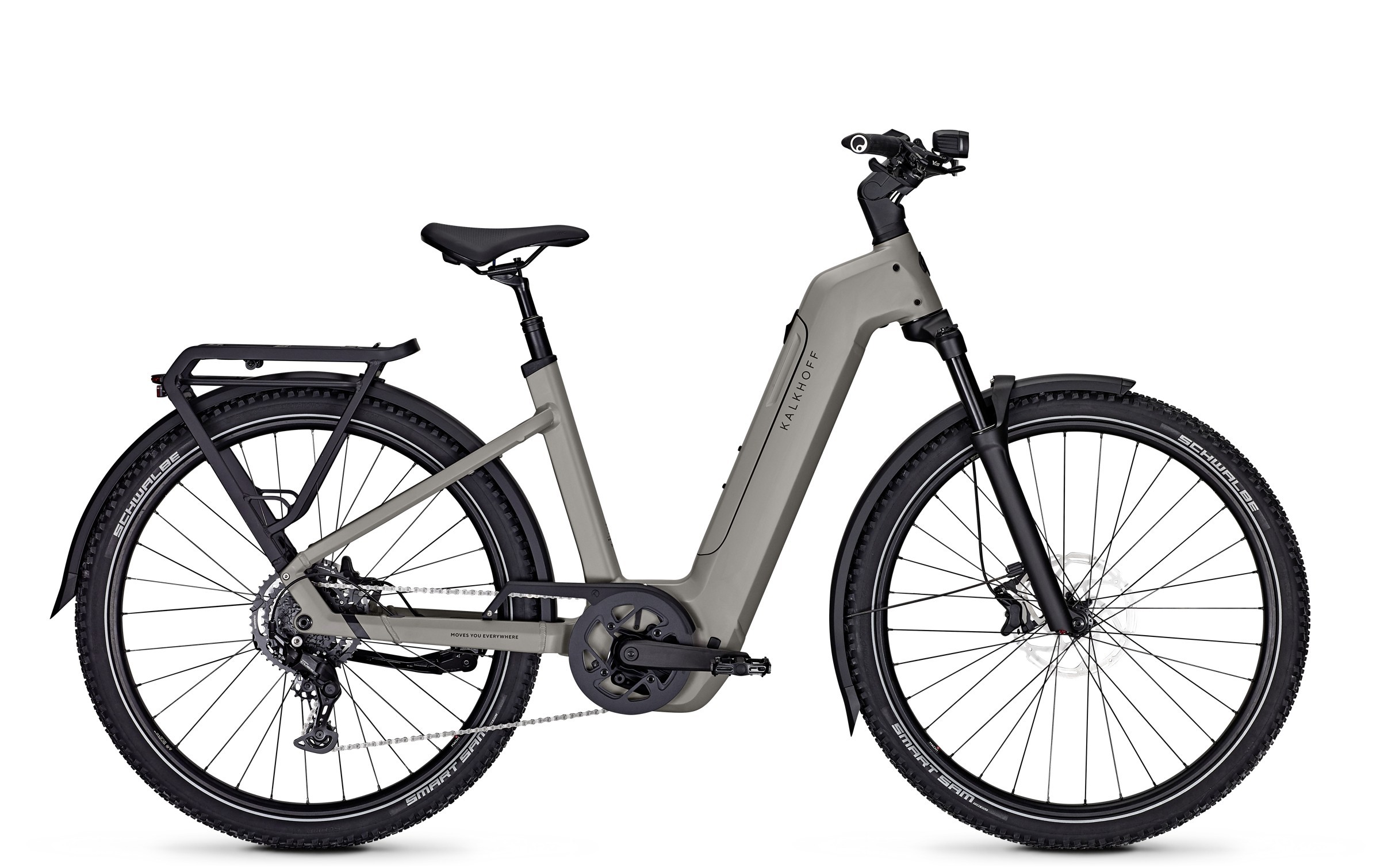
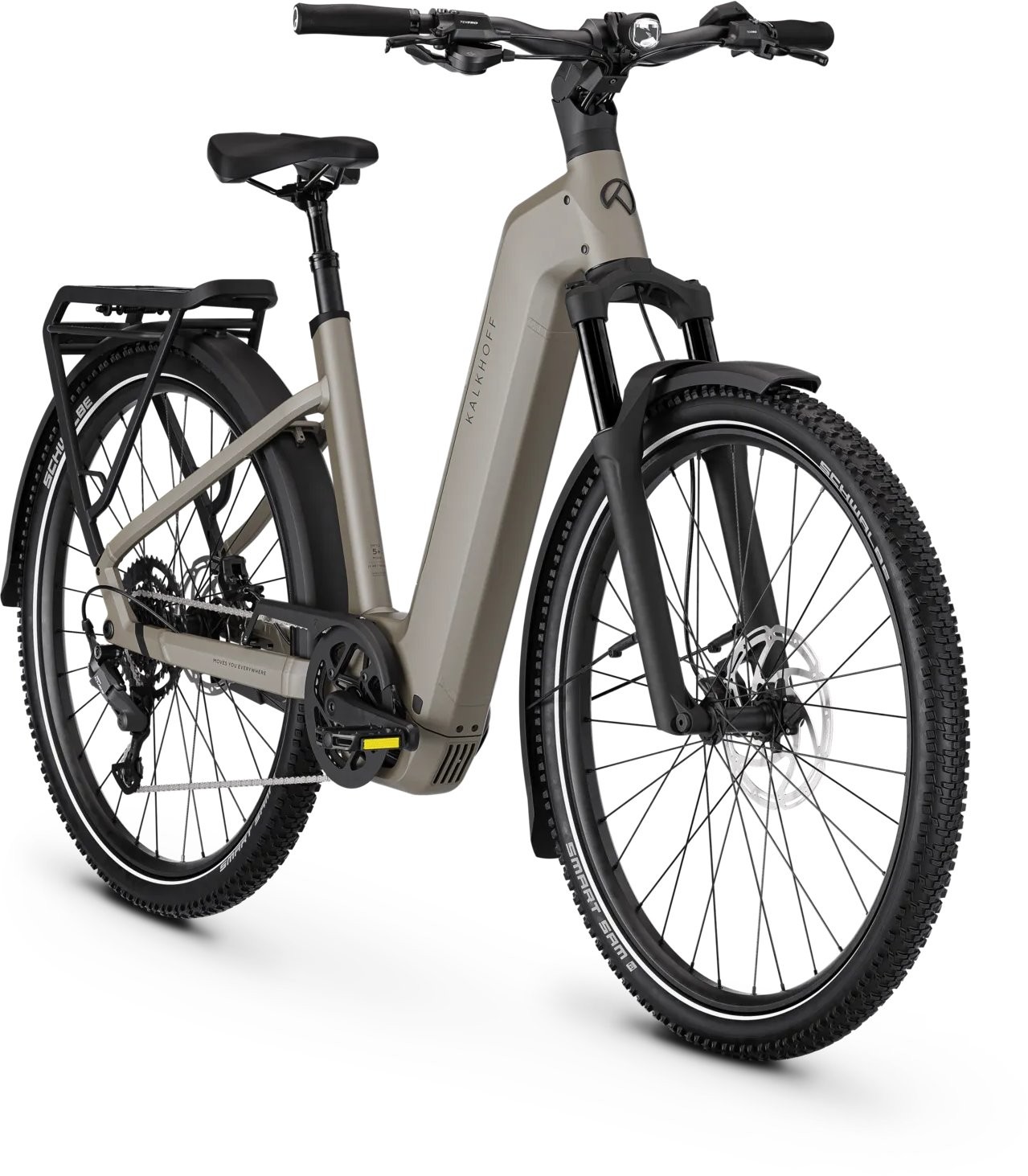
entice_5_move_wa_moonstonegrey_side
entice_5_move_diamond_moonstonegrey_side

Kalkhoff

Kalkhoff Entice 5.B Move

$6,900

(inc. GST)

At a glance:
Technology Bosch Performance Line CX Smart System, 800 Wh battery
Terrain Rail trails and sealed roads
Range Up to 160 km (Kalkhoff, 800 Wh)
What's included?
  • Bosch Performance Line CX Smart System drive and a Bosch PowerTube 800 Wh battery
  • Bosch Purion 200 display, which shows the next service date once we set it
  • Litemove headlight and Spanninga rear light with a brake light, both wired into the bicycle
  • Schwalbe Smart Sam Reflex tyres with a reflective stripe around both sidewalls
  • Full-length aluminium mudguards front and rear with a splash guard
  • A full chain guard, so trousers survive
  • Four-piston hydraulic disc brakes, 203 mm front and 180 mm rear
  • MIK HD rear carrier rated to 27 kg, with a lower pannier rail
  • Adjustable rear stand, so it parks loaded
  • Ergon grips, a Selle Royal Vivo Ergo saddle and a suspension seat post
  • Cockpit 2.0 stem, adjusted to you at handover
  • Set up and fitted to you before you ride it away
  • Servicing seven days a week, in our own workshop, by the shop that sold it
  • Free test ride at our Ivanhoe showroom

Kalkhoff builds this model in three frame shapes. The parts are the same in all three: the same motor, the same battery, the same brakes, the same wheels. What changes is how you get on it, and for a lot of riders that turns out to be the only thing that matters. Not because they want an easier bicycle. Because they want to still be a rider.

At a glance: Kalkhoff Entice 5.B Move specifications
Frame warranty10 years, Kalkhoff
First owner only, and the bicycle has to be registered on the Kalkhoff website within eight weeks of purchase.
FrameWave, step-through
No top tube at all. Step through the opening to get on, and put your feet flat at the lights. Kalkhoff also builds this model as a Diamond.
SizesFive, with a published body-height band each
S 43 cm (150-166), M 48 cm (160-186), L 53 cm (174-191), XL 58 cm (187-196), XXL 63 cm (192-205). Wave runs S to XL.
MotorBosch Performance Line CX Smart System
Mid-drive at the bottom bracket. Assistance scales with how hard you pedal and how fast you turn the cranks.
BatteryBosch PowerTube 800 Wh, 22.2 Ah
Integrated in the down tube behind a key-operated lock. One battery option.
RangeKalkhoff states up to 160 km*
Kalkhoff's own figure. Kalkhoff also names twelve things that change it and says no exact prediction is possible.
DisplayBosch Purion 200
Colour display with walk assist, and it shows the next service date once the workshop has set one.
GearsShimano Cues Linkglide, 9-speed
42 front, 11-46 rear. A wide range for a loaded bike on a hill.
BrakesFour-piston hydraulic disc
203 mm front rotor, 180 mm rear. In Australia the front brake is on the right lever.
Wheels and tyres29 inch, Schwalbe Smart Sam Reflex 57-622
Wider tyres with a reflective sidewall stripe on both wheels.
ForkSR Suntour Mobie34, 120 mm travel
Air fork with a 110 x 15 mm thru-axle.
CarrierMIK HD rear carrier, max. 27 kg
Kalkhoff's rating. Slotted flat top plate with a lower pannier rail.
Permissible total weight180 kg
Kalkhoff defines this as the bicycle plus the rider plus any passengers plus all luggage.
Bicycle weight30 to 31 kg depending on size
Including the battery. Kalkhoff's own figure for size L reads two ways, so we quote the band and check the type plate for you.
Coloursmoonstonegrey matt, meadowgreen matt
Both colours are built in the Wave frame.

The frame

The whole argument for this bicycle is the shape of the space above the down tube.

Kalkhoff builds this model in three frame shapes. The parts are the same in all three: the same motor, the same battery, the same brakes, the same wheels. What changes is how you get on it, and for a lot of riders that turns out to be the only thing that matters. Not because they want an easier bicycle. Because they want to still be a rider.

Wave · the frame we sell

Step through the opening

There is no top tube. A single deep tube drops from the head tube to the pedals and the space above it is open, so you step through instead of lifting a leg over the back wheel. You are never balanced on one leg to get on or off, your feet reach the ground at a stop, and you can step off quickly if you need to. Riders who ride with a basket or a pannier on the rear carrier make a second point about it: there is nothing to kick as you swing on. It is the frame we range and the one we have on the floor at Ivanhoe.

Diamond and Trapez · also built

The higher frames

Kalkhoff also builds the Entice 5.B Move as a Diamond, with a straight top tube, and as a Trapez, with the top tube dropped to meet the seat tube low. Same drive, same battery, same brakes. Diamond runs M to XXL and Trapez runs M and L, so between the three shapes the model covers body heights from 150 cm to 205 cm. If the higher frame is the one you want, tell us and we will order it in.

The part nobody sells on

How many times a day do you get on and off?

This is the argument for a step-through frame that has nothing to do with your body, and none of the thirteen competitor pages read for this one makes it. It is the argument riders make to each other instead.

One of them put it like this: "I used to think getting on and off a bike was just something I had to deal with. Then I started commuting more often and realized how annoying it gets when you're stopping all the time. Red lights, grabbing coffee, quick errands, locking the bike up... you end up getting on and off way more than you think." Nobody counts it. That is rather the point: it is the mount you stopped noticing, and the one that quietly decides whether the bicycle comes out tomorrow.

The community's own version of the case is not about the first dismount of the day. It is about the last one, when a small awkwardness has stopped being small. A frame with nothing to step over takes the awkwardness out of all of them, which is why riders who have no trouble at all swinging a leg over still end up choosing one.

If you carry a basket or a crate on the rear carrier, the same geometry does a second job: there is nothing to swing a leg past as you get on.

From the workshop floor

“It’s worthwhile coming in and trying before you purchase.”

A customer came in a few months apart. The first visit was research. On the second she went out on the size the chart said was hers, wanted to sit quite upright, and the bicycle came up short even after the saddle and the bars were moved. John put her on the next size up and it worked straight away. She had long legs for her height, so the saddle could come up and the bars could come up with it without the bicycle closing in on her. The chart is a starting point. The fit gets decided on the bicycle.

The other story from that week came in with a bicycle for its first free service. Asked how he was finding it, the customer said the cycling group he had drifted away from had taken him back, and that he felt comfortable riding with them again. He had got older, could not hold the pace, felt like he was holding everyone up, and had quietly stopped going. That is what the bicycle turned out to be for. Not the hills.

John (Giampaolo Zanol), founder, Dolomiti Electric Bikes, Ivanhoe. Both accounts are his, recorded on the shop floor. No customer is named.

Book a test ride with John

Reasons people buy this one

The reasons riders give us.

These are the situations people describe when they walk in. If two or three of them sound like your week, this is a bicycle worth coming in to ride.

Getting on

If swinging your leg over the back of a bicycle has become the thing that stops the ride

You step through the opening instead of lifting a leg over. Your weight is never balanced on one leg while you get on or off, your feet reach the ground at the lights, and getting off in a hurry is one step rather than a manoeuvre. It is the part of riding that stopped being automatic, and this frame gives it back.

The hill

If there is one gradient on your route and it is the reason you stopped riding it

The Bosch mid-drive adds assistance in proportion to how hard you are pedalling and how fast you are turning the cranks, so it comes in where you need it rather than in a step. Behind it sits a wide-range nine-speed, 42 at the front and 11 to 46 at the back, which is the gearing that keeps a cadence when the bicycle is loaded and the road tilts.

The shopping

If the short trips you do by car are the ones with something to carry

The rear carrier is a MIK HD platform Kalkhoff rates at a maximum 27 kg, with a slotted top plate and a lower pannier rail. Kalkhoff sets the bicycle's permissible total weight at 180 kg, and defines that as the bicycle plus you plus any passengers plus everything you are carrying. Full mudguards on both wheels and lights that run off the main battery mean it is ready for the trip as it stands.

Who fixes it later

If you are wondering who will still be able to look after this in three years

Kalkhoff publishes a service schedule with eleven intervals running out to 20,000 km or ten years, and the display shows you the next service date every time you switch the bicycle on once we have set one. The frame carries a ten-year Kalkhoff warranty for the first owner, registered within eight weeks of purchase. And we service every bicycle we sell, in our own workshop on Heidelberg Road.

The right size

If no bicycle has ever quite fitted you

Kalkhoff publishes a body-height band for every one of its five sizes, from 150 cm at the small end to 205 cm at the tall end. None of the thirteen we read publishes one. It gets you to the right two sizes before you leave the house, and ten minutes standing over both of them at Ivanhoe settles which one is yours.

The years after

Who services it in three years?

We do. Dolomiti Electric Bikes services every bicycle it sells, in its own workshop at 1075-1087 Heidelberg Road, Ivanhoe. We set the schedule that workshop works to, and it runs a lot further than most people expect.

We ask for the first service at 300 km, then every 6 to 9 months if you ride most days, or once a year if you ride at weekends. That is our schedule and it is the one on your bicycle. Behind it Kalkhoff sets eleven of its own service intervals, falling roughly every 2,000 km or every year, out to interval eleven at 20,000 km or ten years. Each interval has its own checklist, and the pedelec half of it covers the display and controls, the battery, the motor, the charger and the system software as well as the mechanical parts.

The bicycle keeps track of it for you. Once the workshop stores a date or a distance, the Bosch Purion 200 shows the next service due at every switch-on.

One replacement is scheduled rather than left to inspection. At interval eight Kalkhoff instructs that the seat post is replaced at 14,000 km regardless of material and regardless of whether any crack or damage is visible, because a seat post that is not replaced on time can break. It is the only mandatory scheduled component replacement in the whole manual set, and we would rather you heard it here than found it in a manual later.

  • Frame warranty: ten years, from Kalkhoff, first owner only, not transferable.
  • The condition on it: register the bicycle on the Kalkhoff website within eight weeks of purchase. We will do it with you at handover if you want.
  • Wear parts are excluded, as they are on any bicycle: batteries, brake pads, cables, rims, grips, chain, chainrings, tyres, sprockets, bearings and bottom bracket.
  • Kalkhoff's own position on batteries: a loss of capacity that comes with age is not a defect.
  • The drive unit and the battery: not published here. Kalkhoff publishes a ten-year term for the frame and no separate term for the motor or the battery in anything we hold. Your statutory consumer guarantees run from the day we hand the bicycle over, and the answer for your bicycle sits with Kalkhoff's Australian distributor. We have asked, and we will tell you what they say rather than guess.

Nine competitor product pages and four manufacturer sites were read while this page was built. Not one of them says who services the bicycle, where, or what happens in year three. We think that is the question worth answering first.

Book a test ride with John

Before you buy any electric bike

What should you check, on this one or on any other?

The question Australians search most in this category is not which one is best. It is which ones to stay away from. So here is the checklist riders who are still happy years later actually use, written so it works on a bicycle you buy somewhere else.

  • Are the parts common enough that a mechanic already stocks them, or are they proprietary? Here: Shimano gears and cassette, a KMC chain, Tektro brakes, Schwalbe tyres, a Bosch drive and battery.
  • Is there a published service schedule, or does nobody say? Here: eleven intervals, out to 20,000 km or ten years, printed by the manufacturer.
  • Who services it, where, and what happens in year three? Here: us, in our own workshop on Heidelberg Road, Ivanhoe.
  • What does the warranty cover, and what condition is attached? Here: ten years on the frame, first owner, conditional on registering within eight weeks. Wear parts excluded, and no separate published term for the motor or the battery.
  • How big is the battery, and does the seller state the conditions that move the range, or only the headline number? Here: 800 Wh, and the twelve conditions are further up this page.
  • Does the seller tell you what they have not settled? Here: six things a look at the bicycle will close, listed at the end of the specification below, plus a seventh we have put to the distributor.

Take that list to any bicycle in any shop. If a page cannot answer four of the six, the answer is somewhere else in the room.

Fit

Will it fit me?

Kalkhoff publishes the body height each size is built for. None of the thirteen competitor pages read while this page was built publishes one, and it means you can narrow yourself to two sizes before you leave the house. Standing over both of them at Ivanhoe settles the rest.

The Wave frame we range runs S, M, L and XL. The Diamond runs M to XXL and the Trapez runs M and L, so if you are at the tall end the frame shape and the size are one decision rather than two.

The bands overlap on purpose. Where two sizes list your height, the difference is how upright you want to sit and how long your legs are for your height, and neither of those is in a chart. That is a ten-minute question on the bicycle, and it is the reason the test ride exists.

S43 cm frame

150 to 166 cmM48 cm frame

160 to 186 cmL53 cm frame

174 to 191 cmXL58 cm frame

187 to 196 cmXXL63 cm frame

192 to 205 cm

The seat post is adjustable and the Cockpit 2.0 stem adjusts for height, tilt and lateral alignment, so a fit is set on the bicycle rather than picked from a dropdown. If you are not ready to come in yet, there is a smaller step: put your height, the hills on your usual route and what you carry into the booking note, and we will have the two likely sizes on the floor and an answer on the distance before you arrive.

Book a test ride with John

Range

How far will it actually go?

Kalkhoff states up to 160 km for this bicycle on its 800 Wh battery. Kalkhoff also states, in the same manual, that no exact prediction is possible, and names twelve things that move the number. Both halves of that are the honest answer, so here they both are.

In practice that means a flat, warm, unloaded ride in the lowest assistance is a very different number from a hilly, cold, loaded ride in the highest. Experienced riders answer this question with conditions attached and sellers usually answer it without, which is why the number on its own is worth so little.

The useful version of the question is the one we can answer at the counter: tell us the ride you actually have in mind, the hills on it and what you carry, and we will work the distance out with you on the day.

  • Riding style, and how much of the work you are doing yourself
  • The assistance level you ride in
  • Your weight, and the weight of anything you are carrying
  • The gradient of the route
  • The surface, and the rolling resistance of the tyres
  • Tyre pressure
  • Wind
  • Air temperature, and the temperature of the battery
  • The age and condition of the battery
  • Stopping and starting, and how often
  • Gear choice and cadence
  • Whether the lights are running

Range figure and range conditions: Kalkhoff, Original Operating Instructions, and the Kalkhoff product page. Quoted as Kalkhoff's own.

Carrying

What can it carry?

The rear carrier is a MIK HD platform that Kalkhoff rates at a maximum 27 kg. The bicycle's permissible total weight is 180 kg, and Kalkhoff defines that as the bicycle, plus the rider, plus any passengers, plus all luggage including a child seat, a trailer, bags and baskets.

Kalkhoff's own worked example makes the arithmetic plain: a 32 kg bicycle, a 68 kg rider, 15 kg on one carrier, a 20 kg passenger and 15 kg of luggage comes to 150 kg. The figure is a ceiling for everything on the bicycle at once, not a payload on top of you.

The carrier itself is a flat top plate with MIK slots and a lower pannier rail, so a MIK-compatible crate, basket or bag clicks on and off, and ordinary panniers hang from the rail. The engraved rating is on the carrier itself, and we will show you where it is.

One number here is worth comparing. While this page was built, nine competitor product records and four manufacturer sites in this class were read. The permissible total weight they publish runs from 150 kg to 160 kg. This bicycle's is 180 kg, and not one of those thirteen pages explains what the number buys a rider.

  • On child seats, Kalkhoff's rule is specific and we will not paraphrase it away: Kalkhoff permits child seats only on MIK HD carriers with a maximum load capacity of 27 kg, the child seat must have a MIK HD interface, and any other fastening system has to be assessed and confirmed by the Kalkhoff specialist dealer.
  • This bicycle's carrier is a MIK HD rated at a maximum 27 kg. That is the rating Kalkhoff's rule turns on. It does not mean any particular seat is approved.
  • Bring the seat you are thinking of, or its model number, and we will take the question to Kalkhoff with you. We will not tell you a seat fits.
  • Kalkhoff does not permit a child seat on a front carrier, on the handlebars or on a handlebar extension. Child seats should be designed and tested to EN 14344, and trailers to EN 15918.

Do not exceed the load capacity engraved on the carrier, and do not modify the carrier. Those are Kalkhoff's instructions and they travel with the bicycle.

The three frames

One bicycle, three ways of getting on it.

The same colour in all three, so what you are looking at is the frame and not the paint. Wave is the one we sell; the other two are ordered in.

Wave. No top tube. Sizes S to XL.
Trapez. A low top tube. Sizes M and L.
Diamond. The traditional shape. Sizes M to XXL.

The battery

Where does the battery live, and how do I charge it?

This is the question people ask before anything else, and it deserves the manufacturer's own answer rather than ours. Kalkhoff publishes a full handling regime for this battery. It is printed below as Kalkhoff wrote it, unsoftened.

The battery is a Bosch PowerTube 800 Wh, integrated in the down tube behind a full-length cover with a key-operated lock at the top. Five LEDs show the charge, each roughly twenty per cent, and the last one flashes below ten per cent. You can charge it on the bicycle through a socket behind a flap, or with the battery out. It can be charged at any state of charge and interrupting a charge does it no harm.

  • Do not leave the battery unattended while it is charging. Children under eight must not use the charger. Check the charger, the cable and the plug before every use, and never open the charger.
  • Charging is confined to between 0 and 40 degrees by a temperature monitor. Three LEDs flash outside that window, and a charge starting near 0 degrees may be delayed by about five minutes.
  • For storage over three months, leave the battery at 30 to 60 per cent charge, two or three LEDs, and check it after six months. Kalkhoff's ideal storage temperature is 10 to 20 degrees, up to 40 at most and above 0 at least. In winter, store the battery separately and fit it shortly before the ride.
  • Store it dry and well ventilated, out of direct sunlight, away from flammable materials, and in a room with a smoke alarm. Not in a locked vehicle. Kalkhoff says where needed the battery should be stored separately in a fireproof bag or box.
  • Kalkhoff lists the signs of a defective battery: it will not charge with a working charger; the charge LEDs flash irregularly or not at all; charging takes markedly longer without giving more range; the display shows battery error messages; the Bosch app warns; the battery gets conspicuously hot while charging or riding; the battery is swollen or warped; it does not respond when switched on or off; or it shows nothing at all.
  • If any of those appear, Kalkhoff's instruction is direct: a defective battery must not be charged, must not be kept at home, and must be properly disposed of. Bring it to us.
  • If any of that worries you, bring the bicycle and the charger in and we will go through it at the counter. It takes ten minutes and it is part of the handover anyway.

Kalkhoff's own position on ageing: capacity falls with age even with good care, and a markedly shorter run time after a full charge means the battery should be replaced. Unusable batteries come back to us. Every rule above is Kalkhoff's own or Bosch's own, quoted rather than paraphrased; we make no claim about the safety, certification or compliance of any battery, and we would rather hand you the manufacturer's words than our reassurance.

Battery handling, storage, defect signs and disposal: Kalkhoff Original Operating Instructions and the Bosch battery manual Kalkhoff links for this bicycle.

What is fitted

The everyday equipment, and what each piece is actually for.

Lights that are part of the bicycle

A Litemove headlight on the handlebar and a Spanninga Pimento Large at the tail of the carrier, both running off the main battery. The rear unit has a brake light in it. None of the thirteen we read names one. Residual current keeps the lights on after the motor assistance ends.

Seen from the side at night

A continuous reflective stripe runs around the sidewall of both tyres. It is the part of night riding that matters at an intersection, and it is standard here rather than an accessory.

Mudguards on both wheels

Aluminium, extra long, with a splash guard. Rain stops being the reason the trip does not happen.

A full chain guard

A black guard covers the top run of the chain from the crank rearwards. It is on the bicycle in every photograph and it is not even in the specification list. Trousers survive.

Four-piston brakes

Hydraulic discs with four pistons front and rear, a 203 mm rotor at the front and 180 mm at the rear. Across the same thirteen, calliper counts run from two pistons to four, and not one of them makes the piston count a selling line. On a 30 kg bicycle with a load on the back, it is the part you notice on a descent.

A rear stand

Adjustable, mounted under the chainstay behind the pedals, so the bicycle parks loaded without leaning it on anything.

Comfort at the three contact points

An upright riding position, Ergon GS10 grips, a Selle Royal Vivo Ergo saddle and an aluminium suspension seat post. These are the parts that decide whether an hour out is pleasant.

A cockpit you can adjust

The Cockpit 2.0 stem adjusts for handlebar height, tilt and lateral alignment, so the reach is set to you rather than to an average.

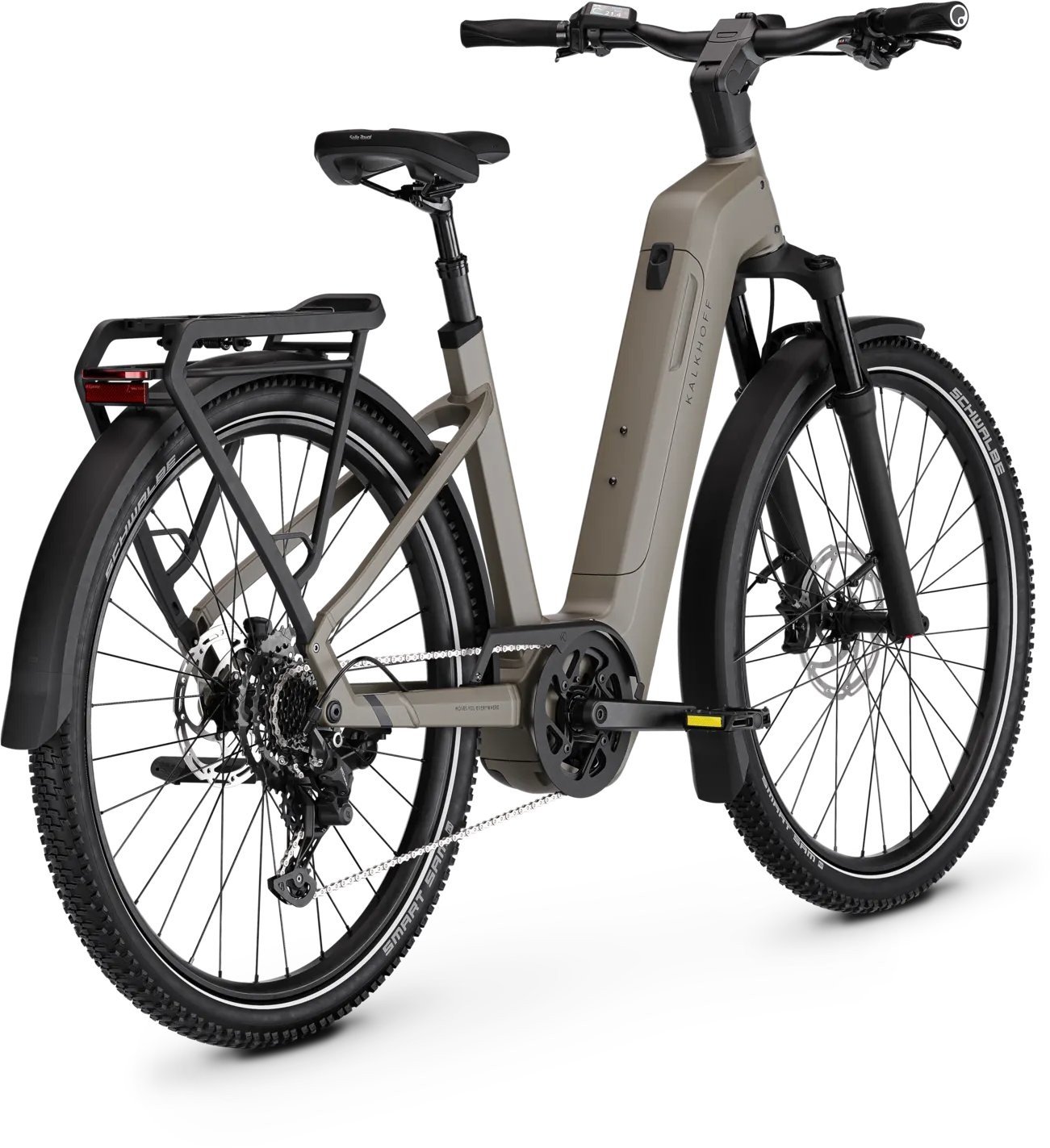
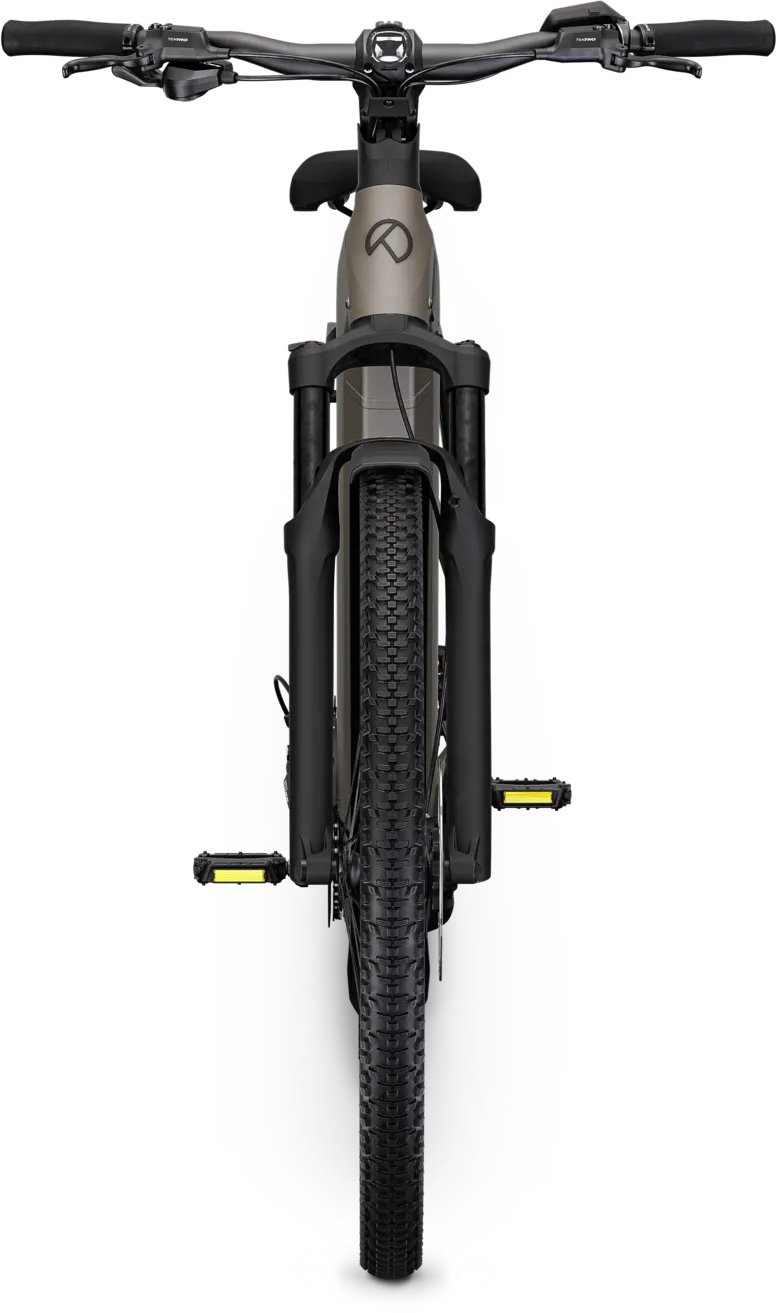
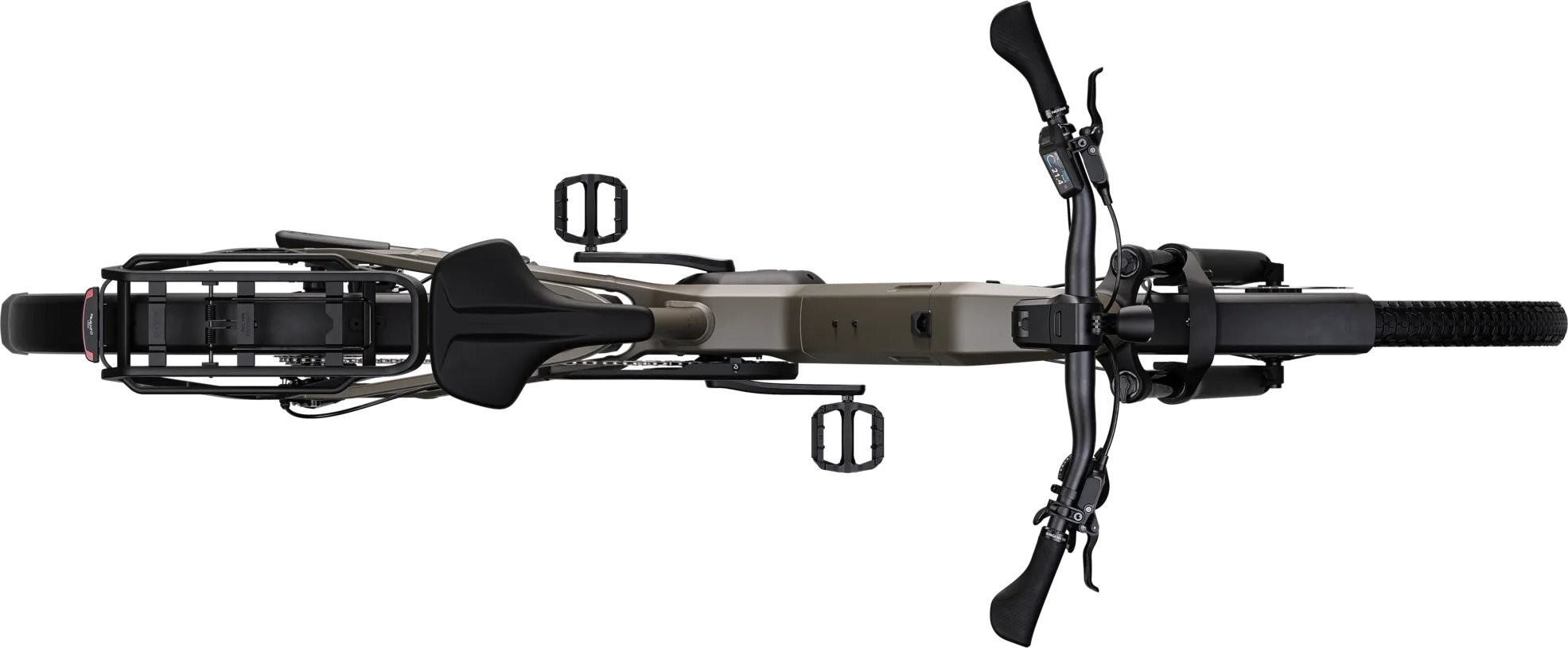
Two more angles

Through the frame, and from behind.

The profile shows the outline. These two show the things the outline cannot.

You can see straight through the frame. This is the picture the step-through claim rests on.
The carrier platform, the rear light at its tail, and the display inboard of the left grip.

Exactly this build

Which Entice is this?

This is the Kalkhoff Entice 5.B Move, Kalkhoff's own name ENTICE 5+ MOVE, article K407-V1. Kalkhoff sells several Entice models in Australia and they are not the same bicycle. The one on this page runs the Bosch Performance Line CX Smart System with an 800 Wh battery, a Bosch Purion 200 display, Shimano Cues 9-speed gears on a chain, four-piston hydraulic disc brakes and a 120 mm SR Suntour fork on 29 inch wheels.

If you have seen an Entice elsewhere with a smaller battery, a belt instead of a chain, a different display or a different fork, it is a different model in the same family. The specification above is the one we range. If you are comparing listings, bring the one you are looking at and we will tell you what is different.

The maker

Who is Kalkhoff?

1919Building bicycles sinceGermanyWhere Kalkhoff Werke sits10 yearsFrame warranty11Published service intervals

Kalkhoff has been building bicycles in Germany since 1919 and has been part of Derby Cycle since 1989. Kalkhoff Werke GmbH is in Emstek, in Lower Saxony, and its name and address are printed in the manual that ships with the bicycle. The specialist title urbanbike.news reviewed an Entice 5+ in September 2025 and called it a powerful, comfortable all-rounder whose high-quality workmanship and well-thought-out details speak for its suitability for everyday use and durability. ebike-mtb.com tested the step-through build of an Entice in August 2025 and called it a well-designed, solidly built step-through everyday bicycle.

What sits behind the badge matters more here than the badge does. Kalkhoff publishes a full service schedule, a ten-year frame warranty with a registration condition, a handover checklist for the shop to work through with you, and a manual that tells you exactly how to look after the battery. Most of that is written down and almost none of it is ever read out loud. This page is us reading it out loud.

What people say about buying here

4.9★from 59 Google reviews of Dolomiti Electric Bikes ★★★★★

“John is the kind of dealer who actually tries to talk you out of buying accessories you don’t need. No upselling, no pressure. That quiet confidence is exactly what you want when making a big purchase.”

Google review, 2026★★★★★

“As someone with zero ebike knowledge, I needed a lot of hand-holding, and John delivered without ever making me feel rushed or pressured. He listened to exactly what I wanted, recommended options that matched my needs, and patiently guided me through a test ride.”

Google review, 2026★★★★★

“Considered, knowledgeable staff, more interested in getting you the right bike than hard selling. Subsequent contacts professional and friendly.”

Google review, 2025★★★★★

“He let me come in and test drive several different bikes on at least two occasions. No hard sell. Recently I had a minor issue with the battery, and John very kindly delivered a replacement battery to my home after hours.”

Google review, 2020

These are reviews of the shop, not of this bicycle, and the strongest theme across them is what happens after the sale: servicing, sourcing a part, fixing a fault. There is no owner review of this model to show you, in Australia or anywhere: we looked, and the review corpus for it is empty. When there is one we will put it here. Google publishes these under first names or initials and we do not republish reviewers' names, which is why each one carries the platform and the year instead.

Common questions

The ones we get asked at the counter

How far will it actually go on a charge?

The full answer, with Kalkhoff's twelve conditions listed, is in the Range section above. The short version: Kalkhoff states up to 160 km on the 800 Wh battery and states in the same manual that no exact prediction is possible. What is not above: the display carries a range screen that recalculates as you ride, so the bicycle keeps answering the question after you own it.

Where do I charge and store the battery?

The manufacturer's full regime, unsoftened, is in the battery section above. What that section does not cover: if the bicycle lives somewhere you would rather the battery did not, the battery is the part that moves, and most owners settle on leaving the bicycle in the garage and bringing the battery inside. That is a habit rather than a rule, and it is the one we would suggest.

Is a step-through frame a compromise?

The argument against it is frame stiffness under a heavy rider, and it is a real argument that gets made in owner forums. The arguments for it come from the same forums and are more specific: it is easier to mount and dismount, which matters most at the last stop of the day rather than the first; it is easier to step off in a hurry if something goes wrong; and if you carry a basket or a crate on the rear carrier there is nothing to kick as you get on. Kalkhoff builds this model in three frame shapes for that reason. Ride the one you are drawn to and see.

Which frame shapes and sizes does it come in?

Three frame shapes. Wave, the step-through, in S, M, L and XL. Diamond, the traditional straight top tube, in M, L, XL and XXL. Trapez, with the top tube dropped low, in M and L. Frame sizes are 43, 48, 53, 58 and 63 cm, and Kalkhoff publishes the body-height band for each one, covering 150 to 205 cm. The Wave is the frame we range and have on the floor. The others we order in.

How heavy is it, and does that matter?

30 to 31 kg depending on size, including the battery. Kalkhoff's own figure for size L reads two ways, so we quote the band and read the type plate rather than pick one. The weight is not something you feel while riding, because the mass sits low. Where you feel it is stairs, a bike rack and lifting it. Plan where the bicycle will live before you buy it, and if there are steps involved, say so and we will work through it with you. The battery comes out, which takes several kilograms off for a lift.

What can it carry, and can I put a child seat on the rack?

The carrier rating, the 180 kg envelope and Kalkhoff's child-seat rule in full are in the carrying section above, and the short answer is that we will not tell you a seat fits. What that section does not cover: if the seat you are considering is not a MIK HD one, there are adapter plates that claim to bridge it, and Kalkhoff's rule puts those in the category a specialist dealer has to assess rather than the category you can buy off a shelf. Bring the seat and we will take it up with Kalkhoff together.

Can I take it on a car rack or in a caravan?

Yes, with Kalkhoff's rules attached, and they are not optional. The rack has to be rated for pedelec weight, which many are not. Take the battery out and carry it in a bag that protects it from heat, shock and impact. Take the panniers and attachments off. Give the motor and the docking station rain protection. And secure the bicycle by its seat post, never by clamping the frame. If you are travelling with it, come in before the trip and we will check the rack with you.

How does it handle hills?

The Bosch mid-drive adds assistance in proportion to how hard you are pedalling and how quickly you are turning the cranks, in every mode, so it arrives smoothly rather than in a step. Behind it is a wide-range nine-speed with 42 at the front and 11 to 46 at the back, which is what lets you hold a comfortable cadence with a load on the back and the road rising. Numbers are a poor guide here and the hill you actually ride is a good one. Bring it to the test ride.

Are the components any good, and will the drivetrain wear out?

Shimano Cues 9-speed with a Linkglide cassette, KMC chain, Tektro four-piston hydraulic disc brakes, Schwalbe tyres, Ergon grips, Selle Royal saddle. These are parts a bicycle mechanic already stocks, which is the thing experienced buyers actually check for. On wear: a mid-drive puts real load through a chain and cassette, and owners of e-bikes across every brand report faster drivetrain wear than they are used to. Linkglide is Shimano's answer to exactly that. Kalkhoff's own instruction helps too, and almost nobody says it out loud: briefly ease off the pedals as you change gear. It makes the shift cleaner and takes load off the drivetrain.

Who services it, and how often?

The eleven intervals, the first service and the seat-post replacement are in the service section above. What is not there: bring the bicycle in for the first service and we set the reminder on the display at the same time, so the bicycle tells you when the next one is due rather than you having to remember.

Is Kalkhoff any good?

Kalkhoff has built bicycles in Germany since 1919 and has been part of Derby Cycle since 1989. The specialist title urbanbike.news reviewed an Entice 5+ in September 2025 and called it a powerful, comfortable all-rounder whose workmanship and detailing suit everyday use. ebike-mtb.com tested a step-through Entice in August 2025 and reached the same verdict. Both are worth reading in full rather than taking from us. If you go looking for long-term Kalkhoff ownership reports you will find a large body of writing about motor failures, and it is worth knowing what it is about: it concerns Kalkhoff's own Impulse drive unit from roughly 2014 to 2019. This bicycle carries a Bosch Performance Line CX Smart System, which is a different system from a different manufacturer, and that history does not attach to it. What we will not do is leave the question half answered: if you are asking what happens when a motor or a battery fails, Kalkhoff publishes a ten-year term for the frame and no separate term for either of those in any document we hold. Your statutory consumer guarantees run from the day we hand the bicycle over, we have asked Kalkhoff's Australian distributor for their position, and we will tell you what they say rather than guess. In the meantime the machine comes back to our workshop on Heidelberg Road, which is the part we control.

Why do the brake levers feel the wrong way round?

They may not be, and this is worth reading before your first ride. Kalkhoff sets the front brake on the left lever, and its own manual states that this is exactly the reverse in Australia, where the front brake is on the right. If you are used to the Australian arrangement, tell us and the workshop rearranges the levers before you set off. It is one of only two places in the entire manual set where Kalkhoff names Australia, and it is the one that matters on day one.

The best way to know is to get on it

Come and ride the Entice 5.B Move at Ivanhoe.

Step through it once and you will know within a minute whether the frame is the answer to the thing that has been stopping you. Ten minutes standing over two sizes settles which one is yours. 4.9 from 59 Google reviews. There is no pressure to buy on the day.

Book a test ride with John

Dolomiti Electric Bikes
1075-1087 Heidelberg Road, Ivanhoe VIC 3079
We range the Wave step-through frame in moonstonegrey matt and meadowgreen matt. The Diamond and Trapez frames, and the sizes we do not hold, are ordered in.

Key Specifications

Motor

Bosch Performance Line CX Smart System, 250 W mid-drive. Assistance runs to 25 km/h.

Battery

Bosch PowerTube 800 Wh, integrated in the down tube. It lifts out on a key lock so you can charge it indoors.

Brakes

Four-piston hydraulic discs, 203 mm at the front and 180 mm at the rear.

Lights

Litemove headlight and a Spanninga Pimento Large at the rear with a brake light. Both wired into the bicycle.

Display

Bosch Purion 200, which shows the next service date once it is set.

Gears

Nine-speed, 42 at the front and 11 to 46 at the back.

Interested in the Kalkhoff Entice 5.B Move?

Then come down to our showroom and take it for a test ride. If you fall in love and want to take it home, we have flexible payment options to suit most budgets.

Visit us

Other products you might like